Stop Living in Chaos: Easy Home Organisation Tips That Actually Stick in 2026
If your home feels more like a storage unit than a sanctuary, you are not alone. Easy home organisation tips can transform any cluttered, stressful space into a calm and functional home without requiring a full weekend, a huge budget, or a Pinterest-perfect vision.
This guide covers the most practical, beginner-friendly strategies used by professional organisers in 2026, from quick daily habits to room-by-room systems that actually last.
Why Most People Fail at Home Organisation (And How to Fix It)
Most people try to organise everything at once. That is the number one mistake. Tackling your whole house in a day often leads to frustration. Instead, choose one small area such as a drawer, a shelf, or a corner of a room.
The secret is momentum. One small win leads to another. Once you feel the calm of a single organised space, you will want more of it.
The Golden Rule: Declutter Before You Organise
You cannot organise clutter. Buying more bins and baskets on top of too much stuff just creates tidier-looking chaos.
Before you think about storage solutions or containers, take time to remove what you no longer need. Go through your items and ask yourself if you use them regularly or if they add value to your life. If not, consider donating or letting them go.
Quick declutter checklist:
Keep only what you use at least once a month. Toss anything expired, broken, or without a matching pair. Donate items in good condition you have not touched in six months. Keep no more than three water bottles per person and if it has no lid, it goes in the bin.
Keep a donation box near your back door throughout the week and toss in items you no longer need. The moment the box is full, it goes straight to your car for drop-off.
Easy Home Organisation Tips by Room
Kitchen: The Heart of Your Home Organisation
The kitchen collects clutter faster than any other room. A few simple systems fix this permanently.
Pantry organisation tips:
Transfer loose items into clear, uniform jars or containers. Group by category such as baking, grains, snacks, and canned goods. Spices are an easy starting point, and if they are expired or unopened, throw them away. Use labels so every family member knows where things live.
Activity-based zones work brilliantly in kitchens. Create a coffee and tea zone, a baking zone, and a kids’ lunch zone so that everything needed for a specific task is in one spot, eliminating the frustration of searching.
| Kitchen Zone | What Goes There |
| Coffee and Tea Zone | Kettle, mugs, coffee, teabags, sweetener |
| Baking Zone | Flour, sugar, baking trays, mixing bowls |
| Kids’ Lunch Zone | Lunchboxes, snacks, sandwich bags |
| Cleaning Zone | Spray bottles, cloths, washing-up liquid |
Bedroom and Wardrobe: The Daily Stress Reducer
A chaotic wardrobe makes every morning harder than it needs to be. The fix does not require a luxury walk-in, just a smarter system.
Wardrobe organisation tips:
Hang clothes by category such as tops, trousers, dresses, and jackets. Use matching hangers for an instantly cleaner look. Keep a small donation bag inside the wardrobe so when something new comes in, something old goes out.
Try photographing outfit combinations you already own so you stop buying duplicates and always know what you have.
A valet rod lets you prepare tomorrow’s outfit in advance, keeping everything neat, accessible, and wrinkle-free. Even a small addition like this can make a big difference in your daily routine.
Entryway: The First Line of Defence Against Clutter
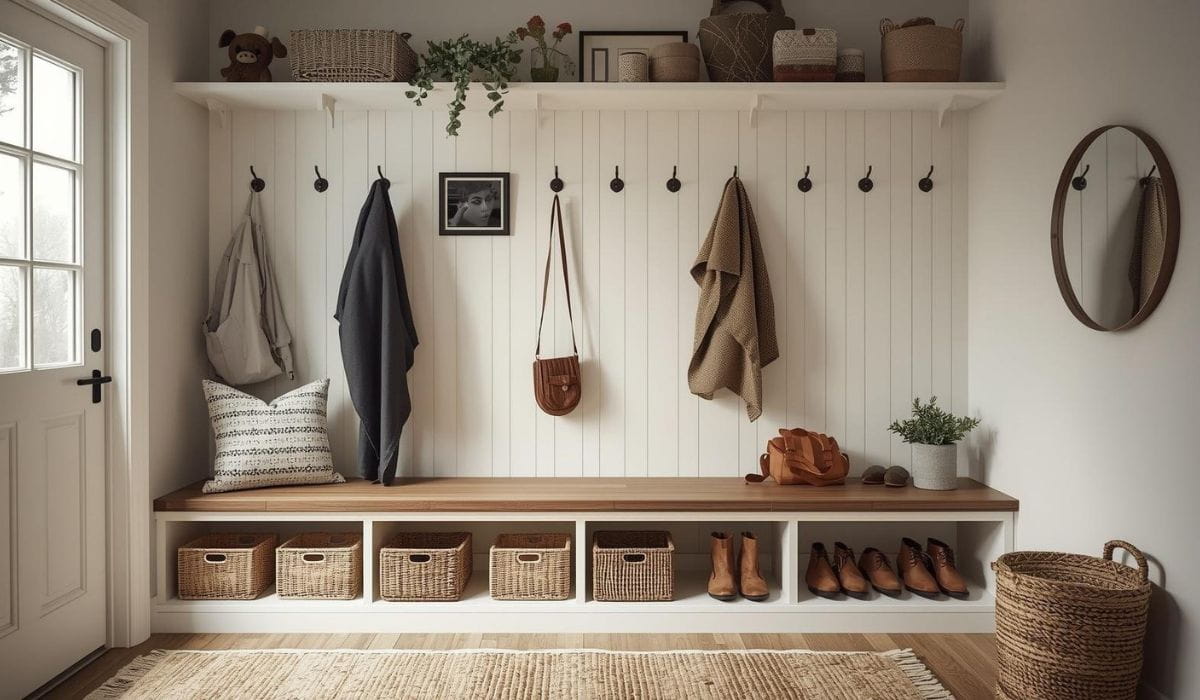
Entryways often collect clutter from shoes, coats, bags, and daily items. Adding cubbies, hooks, and benches creates a designated drop zone, keeping things tidy and accessible.
Every family member should have their own hook. Shoes go in one spot. Keys live in one bowl. When every item has a fixed home, clutter stops spreading through the rest of the house.
Bathroom: Calm in a Small Space
Bathrooms get cluttered with half-used products and expired items. Clear them out first, then organise what remains.
Bathroom zone ideas:
The daily essentials zone holds your toothbrush, face wash, deodorant, and moisturiser. The first aid zone keeps plasters, antiseptic, and paracetamol together. The back-stock zone stores spare soap, shampoo, and toilet rolls.
Even keeping skincare in a small tray on your counter makes your morning routine faster and less stressful.
Home Office: Stop the Paper Chaos
Paperwork is one of the most ignored clutter sources in British homes. Create an inbox tray for items needing action.
File or shred anything older than one year. Go digital where possible by scanning important documents and shredding the originals. Use a labelled drawer divider for pens, chargers, and stationery.
The Best Organisation Systems for Long-Term Success
The One-In, One-Out Rule
The One In, One Out rule prevents clutter before it starts. When something new arrives in your home, something old leaves. Keep a donation bin in your wardrobe, laundry room, or garage so you can follow through immediately.
This single habit eliminates the need for big annual decluttering sessions entirely.
The Two-Minute Rule
If something takes less than two minutes to do, do it right now. Most clutter is not the result of big messes. It is the little things left undone such as mail not sorted, dishes left in the sink, and shoes not put away.
The 80% Container Rule
A container is not meant to be a place to cram everything. It is a boundary. A good container should feel about 80% full. If it is stuffed, it is time to reassess what actually needs to stay, not upgrade to a bigger bin.
The Sunday Reset Ritual
Spend 20 minutes every Sunday resetting your home. Put things back, wipe surfaces, and check your donation box. This stops small mess from becoming overwhelming clutter by the following weekend.
People are increasingly treating organisation as a form of self-care, with simple systems designed to make daily routines smoother and homes feel more peaceful.
Smart Storage Ideas to Maximise Every Inch
Most homes waste enormous amounts of vertical space. You do not need more floor space, you need to go up.
| Storage Hack | Best Room To Use It |
| Wall-mounted shelving | Living room, home office, bathroom |
| Over-door organisers | Bedroom wardrobe, bathroom door |
| Under-bed storage boxes | Bedroom for seasonal items and spare bedding |
| Drawer dividers | Kitchen, bathroom, home office |
| Clear stackable bins | Pantry, garage, utility room |
| Tension rods | Under sink for spray bottles and inside drawers |
Tall shelving units, wall-mounted cabinets, and overhead storage make the most of every inch whether in closets, pantries, garages, or utility rooms. Vertical storage allows you to store more without crowding your floors.
Label everything. Labelling is one of the simplest organisation rules to implement and one of the easiest to maintain. It turns chaos into calm and makes your space feel more structured without any extra effort.
Organisation as Self-Care: The 2026 Mindset Shift
Getting organised does not mean aiming for perfection. It is about setting yourself up to maintain calm in the middle of real life. Your house does not have to be perfect all the time, but if a system is in place, it will be far easier to manage when life gets busy.
The goal is not a showroom home. The goal is a home that works for you. That shift happens one small system at a time and the reward is walking into your home and feeling peace instead of pressure.
Final Thoughts: My Experience With These Tips
After applying the one-in-one-out rule and the Sunday reset to my own home, the difference was noticeable within two weeks. The biggest change was not the storage solutions.
It was assigning a fixed home to every single item. Once everything had a place, tidying went from a 45-minute chore to a 10-minute routine. Start with one drawer and you will not stop there.
FAQs: Easy Home Organisation Tips
What is the easiest room to start organising at home?
Start with the room that causes you the most daily stress. For most people that is the kitchen or the entryway. One organised space builds the motivation to continue room by room.
How do I stay organised after I tidy up?
Use the one-in-one-out rule and a weekly reset ritual. Systems only work when they are maintained. Spending 15 to 20 minutes each Sunday resetting your home prevents clutter from rebuilding throughout the week.
Do I need to buy expensive storage products to get organised?
No. Decluttering first is completely free and makes the biggest difference. Basic bins, a label maker, and drawer dividers cover most storage needs at very low cost.
What is the 80% container rule in home organisation?
A storage container should never be more than 80% full. If it is overflowing, you need to declutter the contents rather than buy a bigger container.
How long does it take to organise a home?
Going room by room at a manageable pace, most homes can be fully organised in two to four weekends. Working in 10 to 15 minute daily sessions is just as effective when done consistently over time.
What do professional organisers recommend for small UK homes?
Vertical storage, multi-functional furniture, and strict one-in-one-out rules are essential in smaller spaces. Every item must earn its place and justify the space it takes up.
How do I stop clutter from coming back?
Set a permanent donation box in your home. Practise the two-minute rule daily. Never allow items to pile up without a fixed home assigned to them.
What is the Sunday Butterfly method?
The Sunday Butterfly method involves moving through your home, spotting tasks that need doing, and completing them there and then.
It is especially effective for people with ADHD or neurodivergent minds who need a low-pressure, flexible approach to tidying.
Is home organisation good for mental health?
Yes. Research consistently shows that a tidy, organised environment reduces cortisol levels, lowers anxiety, and improves focus and mood. In 2026, organisation is widely recognised as a genuine form of everyday self-care.